
Microchip PIC18F2585-I/SO: An In-Depth Technical Overview and Application Guide
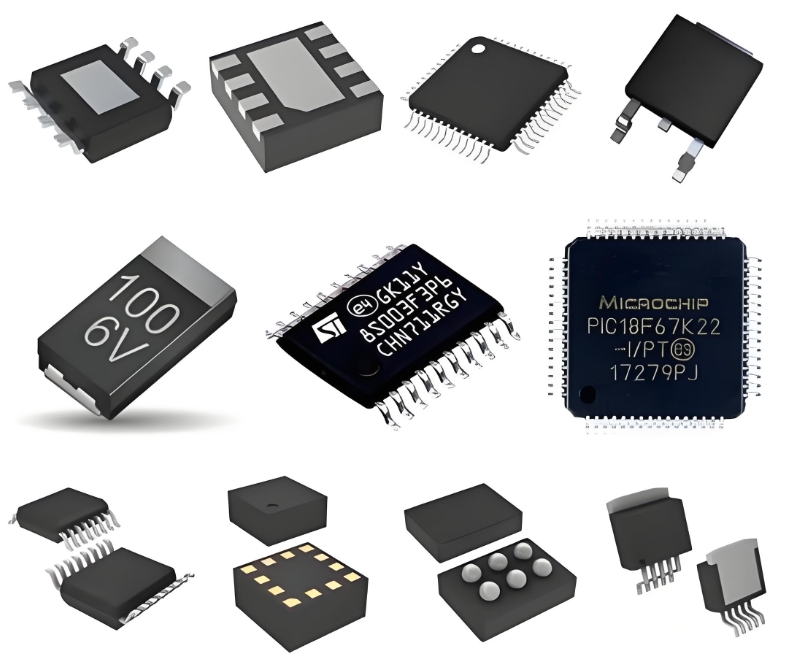
The Microchip PIC18F2585-I/SO stands as a robust and versatile 8-bit microcontroller within Microchip's extensive PIC18 family. Housed in a 28-pin SOIC (Small Outline Integrated Circuit) package, this device is engineered for applications demanding high-performance computation, sophisticated peripheral integration, and reliable communication capabilities. Its architecture is built around an enhanced PIC18 core with a 16-bit instruction set, enabling efficient C code execution and offering a significant performance boost over earlier 8-bit generations.
Core Architectural Features
At its heart, the PIC18F2585 operates at speeds up to 40 MHz, achieving 10 MIPS (Million Instructions Per Second). It incorporates 32 Kbytes of flash program memory and 1.5 Kbytes of RAM, providing ample space for complex firmware. A standout feature is its 1 Kbyte of EEPROM data memory, which allows for the non-volatile storage of critical data such as calibration constants or user settings without requiring an external chip.
A key strength of this microcontroller is its integrated CAN (Controller Area Network) 2.0B module. This peripheral is essential for developing robust industrial automation, automotive, and networked embedded systems where reliable serial communication is paramount. The module supports both standard and extended data frames.
Complementing the CAN module are several other communication interfaces:
EUSART (Enhanced Universal Synchronous Asynchronous Receiver Transmitter): For RS-232, RS-485, and LIN bus communication.
MSSP (Master Synchronous Serial Port): Configurable as either an I2C or SPI interface, enabling communication with a vast ecosystem of sensors, memories, and display modules.
10-bit Analog-to-Digital Converter (ADC): With up to 10 channels, it is capable of accurately digitizing multiple analog signals from sensors.
Application Guide and Design Considerations
The PIC18F2585-I/SO is exceptionally well-suited for a range of demanding applications:
Industrial Control and Automation: Its CAN bus capability makes it ideal for nodes in a factory automation network, motor control units, or sensor gateways.
Automotive Electronics: Used in subsystems like body control modules, dashboard displays, and sensor interfaces where ruggedness and reliable communication are required.
Medical Devices: The combination of processing power, non-volatile EEPROM, and multiple communication protocols supports portable diagnostic equipment and patient monitoring systems.
General Purpose Embedded Systems: Serves as a powerful core for complex projects requiring extensive peripheral control and data logging.
When designing with this microcontroller, developers should leverage Microchip's MPLAB X Integrated Development Environment (IDE) and the XC8 compiler. These tools streamline code development, simulation, and debugging. Special attention should be paid to the power supply decoupling and PCB layout for the high-frequency crystal oscillator to ensure stable operation. Furthermore, utilizing the on-chip ECAN module's mask and filter registers is crucial for efficient message handling in a busy CAN network, reducing the MCU's interrupt load.
ICGOOODFIND
The Microchip PIC18F2585-I/SO is a highly integrated and powerful 8-bit microcontroller that excels in connectivity-centric applications. Its integrated CAN 2.0B module, substantial memory configuration, and rich set of peripherals make it a superior choice for developers building systems for industrial, automotive, and other demanding environments. It successfully bridges the gap between basic 8-bit MCUs and more complex 32-bit counterparts, offering a compelling blend of performance, features, and design maturity.
Keywords: CAN Bus, PIC18 Microcontroller, Embedded Systems, 8-bit Architecture, Industrial Automation

